May 31, 2023
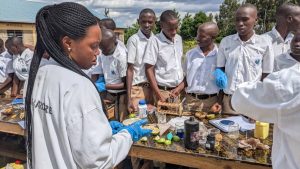
Wednesdays are an easy day for me this term – just two classes and they begin after lunch. Since I haven’t had a day off in forever, I lazed around my house in the morning and charged into school around 12:30 to eat lunch and then deliver my classes to 10th graders who are studying Early Childhood & Lower Primary Education. I returned their Unit 7 tests to them and was preparing to have them practice two dialogues, one between a teacher and a parent and the second between a teacher and an administrator about problems with a student. No sooner had I modeled the dialogue with a student when Jean de Dieu, a biology teacher, came and asked if he could borrow my students for 20 minutes to take them outside to do a science experiment with Tutor Alice and Tutor Matara from Zimbabwe. (As you can see, we have no science lab.) 20 minutes turned into 2 hours and there went my class. As this is the end of the semester and school year, I understand that everyone is vying for time with the students to finish the curriculum. As a Peace Corps Volunteer, you learn to let go and not get upset. Personally, I just can’t get mad at Rwandans – they are too nice of people!
May 28, 2023
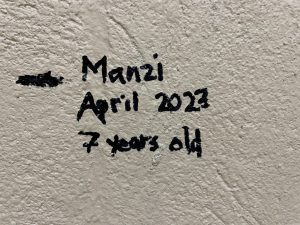
Last month, I measured Mr. Manzi against the wall in my house. In typical 7-year-old fashion, for the next two days, he came over put his hand on top of his head and moved it to the wall to see if he had grown any.
Emmanuel, the high schooler who cleans my house, has also picked up ironing duties to make more money. He lives just down the lane about 200m. After he finished ironing my clothes, he asked if he could borrow the iron so that he could iron his clothes. I said sure, and went to put the iron in a bag for him to take home. He said, “Tim, I don’t have electricity at my house.” I had completely forgotten about this.
A couple of weeks ago, I tried to break the news to Manzi that I will be leaving Rwanda soon. Without missing a beat, he said, “And you’re going to bring me back a turtle.” The other day he said that he checked with his father and he can go to the U.S. with me.
Our 11th graders were learning poetic devices yesterday. I asked Emmanuel to express how lovely Alice, the student sitting next to him, was using a simile or metaphor. He thought about it for a bit and said, “Alice is a beautiful as a banana.” She wasn’t happy.
\
May 27, 2023
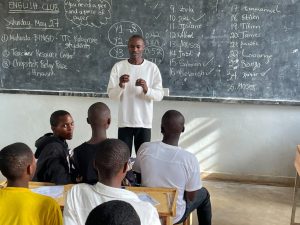
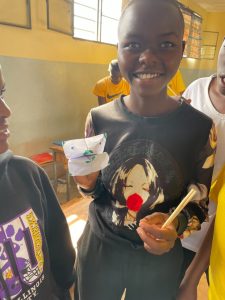
One of my duties at Kabarore Teacher Training College is English Club on Saturday afternoons. I share the duty with Tutor Georgina from Zimbabwe. Today was my turn. The students really like to play BINGO, so we play that every week that I run EC. I give every student a “matunda” – passion fruit to play and the winner gets a couple more. I have the students lead the game, with one student acting as teacher and giving the clues. Another activity we did last week was to make fortune tellers and I asked the students how they would use them in the classroom. They had some really clever ideas of how to use them, such as for dialogues, teaching fractions and practice following oral directions. Today I gave the students chopsticks that I bought in Kigali. We played a relay race with them, but a focus was to ask them how they would use them in their classrooms. Again, they had some really clever ideas on using chopsticks to teach math, spelling, music, etc.
May 26, 2023
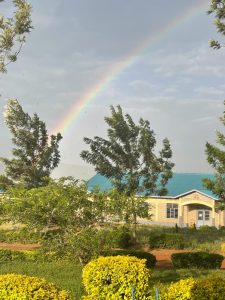
Today, while giving a test at the end of the day, I noticed that it was raining lightly while the Sun was out. The Rwandans have a curious expression for this, “The hyena is getting married.” I have no idea what the origin of this is. Sandra, the Peace Corps volunteer who also lives in Gatsibo province, said the Spanish expression is, “The witch is getting married.” Interesting how two cultures so far apart settled on marriage as a way to describe rainfall as the Sun is shining. When I asked my Zimbabwean colleagues about this, they said that they don’t have a similar expression. Many of the Zimbabweans speak Dereva, which has clicking sounds and other creative uses of the mouth as part of their phonology, and my colleague Joyce taught me the word for “rainbow” (which I quickly forgot) – you couldn’t call it a tongue twister but it’s really hard to pronounce. Here is the photo of the rainbow which visited Kabarore this afternoon.
May 25, 2023
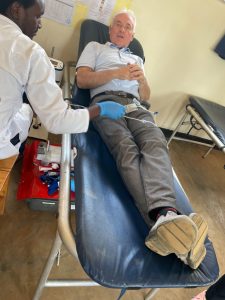
Happy Africa Day! (May 25) I had never heard of this holiday until this morning. It’s a working holiday in Rwanda so school was in session. Between my four classes and grading Tuesday’s tests, I donated blood. The Rwandan Biomedical Center (great slogan: “Healthy People, Wealthy Nation”) came to TTC Kabarore to collect blood, as they did last term. A lot of students were there to donate. I was Customer #1 and they gladly took my O+ blood. Incidentally, most Rwandans have O+ blood which might be why we get along so well. There is a real lack of space at our teacher training college and the medical folks used the room where the assistant principal (dean of students) and directors of discipline usually sit to set up shop.
May 23, 2023
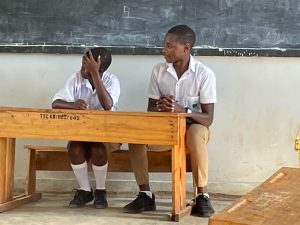
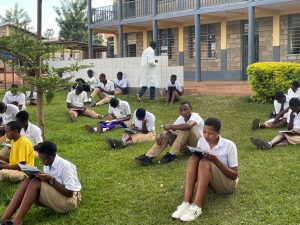
Today the 11th graders put their knowledge about Human Rights and Ethics, the content from Unit 7 in our textbook, to work. This part of the text was quite good at preparing future teachers for their roles as caretakers of children, and we studied all 42 rights accorded to children by the United Nations. The future teachers of Science and Math put on skits dealing with the rights of children. There was a lot of good acting, good plots and problem resolution at the end of each skit. The future Language Education teachers took a traditional end-of-unit test. Because the weather was nice, we were able to sit out on the lawn. I will grade the tests on the bus tomorrow as I go to Kigali to reapply for a passport at the US Embassy. That was my Tuesday afternoon – 3 classes from 2:45 to 5 p.m. It was a good day at TTC Kabarore.
May 21, 2023
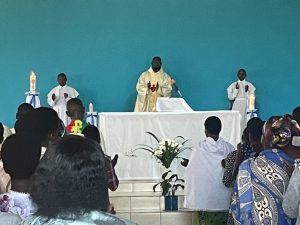
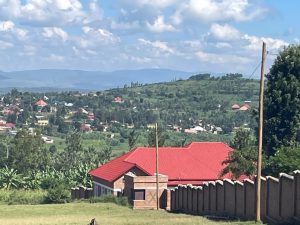
On Sunday, the Catholics in Kabarore attend mass at 7 a.m. The mass lasts for almost three hours because of the amount of beautiful singing from the choir and the length of the homily, but other than that, it’s exactly the same as anywhere else. Today our priest was a man from Congo and not the usual Fr. Eric. I didn’t realize that his Kinyarwanda wasn’t native until my friend Denis told me afterwards. Catholic churches usually have prime real estate in any town but not in Kabarore – the church is way up the side of a hill. To get there, I have to walk about 35 minutes and like most Americans, I’m not a recreational walker, so it’s a bit of a hike. The church itself is quite plain, and there is no sign to indicate which saint or religious name it is named after. The pews are just benches and Stations of the Cross are just pictures tacked to the wall. Sunday mass is always packed out with approximately 600 adults and about 100 kids in the children’s section. There are almost always two collections and today there was a third so that they could pay the salary the nightwatchman. I feel really welcome here and they have asked me to speak a couple of times during the announcements after mass. I can’t say too much in Kinyarwanda but I let the congregation know I’m grateful to be among them. Soon I will be saying goodbye to them and the Peace Corps’ language trainers will help me craft an appropriate short speech in Kinyarwandan.
May 21, 2023
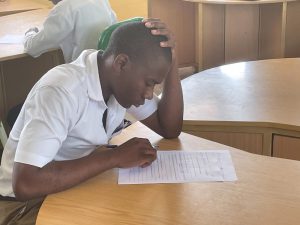
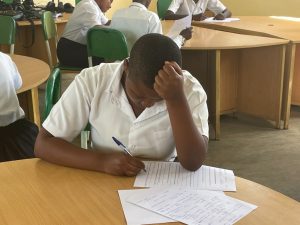
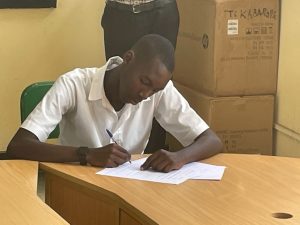
This May, the Rwandan Education Board created an English Language Skills competition for all 16 teacher training colleges throughout the country. Kabarore was the host for the Eastern Region, and we welcomed teacher trainers from Matimba, Zaza and Bicumbi. The competition was divided into four parts: Listening, Speaking (Debate), Reading and Writing. I coached the Kabarore team in listening. The students had to listen to an audio clip then write the answers in Round One, and then they had to listen to a second audio clip followed by oral questions in Round Two. The TTC Kabarore team came in second place. Mr. Aime finished fourth of twelve students, Ms. Teta Benise was fifth and Mr. Divine was sixth. Here they are hard at work on the writing portion of the listening test.
May 20, 2023
This May, the Rwandan Education Board created an English Language Skills competition for all 16 teacher training colleges throughout the country. Kabarore was the host for the Eastern Region, and we welcomed teacher trainers from Matimba, Zaza and Bicumbi. The competition was divided into four parts: Listening, Speaking (Debate), Reading and Writing. I coached the Kabarore team in listening. The students had to listen to an audio clip then write the answers in Round One, and then they had to listen to a second audio clip followed by oral questions in Round Two. The TTC Kabarore team came in second place. Mr. Aime finished fourth of twelve students, Ms. Teta Benise was fifth and Mr. Divine was sixth. Here they are hard at work on the writing portion of the listening test.
(add photos)
May 16, 2023
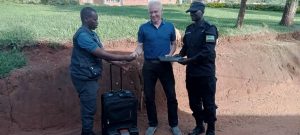
I got good news today: The Rwandan Police located some of my things that were stolen over a month ago. This afternoon, my principal pulled me out of class and brought me to the police station to ID my things. I’d say I got about half of my things back, including $143 and a broken computer. What’s still missing is my passport, my favorite piece of luggage and most of my work clothes. The thieves – two men and a woman – were there in handcuffs at the police station this afternoon. I asked if I could address them and my principal interpreted. I told them that I forgave them and shook their hands, and they were grateful for that. I explained the reason why I was in Rwanda, and that they hurt me a little but hurt my students more by taking away the tools I use to teach. I explained it was like taking a hoe from a farmer. I hope my message got across. Here I am with Mr. Phocus and Mr. Gashuma from the Rwandan Police.